Starting a New Nonprofit
Resources & Information
We’re often asked: “What does it take to start a new nonprofit organization?” CNM offers a recurring informational seminar on the subject and, through our Helpline, each month answers dozens of questions about the steps involved in creating a new nonprofit organization.
With the help of Public Counsel, we’ve put together these informational pages that review the core concepts and key steps shared in this popular course. Please note that these webpages are intended as a general overview of the concepts and issues involved in forming a charitable tax-exempt nonprofit corporation, and is not intended to provide specific legal advice.
This webpage should not be construed as all-inclusive, nor as the provision of legal services to any individual or entity; reading this webpage does not create any lawyer-client relationship.
Last Updated on December 8, 2020
What is a nonprofit?
There is no legal definition of nonprofit. When we use the term in these resources, we are talking about a California Nonprofit Public Benefit Corporation that is exempt from federal taxation under section 501(c)(3) of the Internal Revenue Code. A Nonprofit Public Benefit Corporation is:
A separate legal entity
Organized and operated for a recognized public or charitable purpose
May not distribute corporate assets
Should you form a new nonprofit?
Questions to Consider
Size and scope of proposed programs
Resources available to comply with filing requirements and laws
Existing volunteer or employment opportunities
What is required by potential funding sources?
Are there alternatives?
Cost of formation and compliance vs. cost of alternatives
Alternatives to Forming a New Entity
For-profit entity (e.g., donating proceeds to charity, B-Corp models, targeted hiring)
Join/volunteer with an existing nonprofit
Start-Up Fees
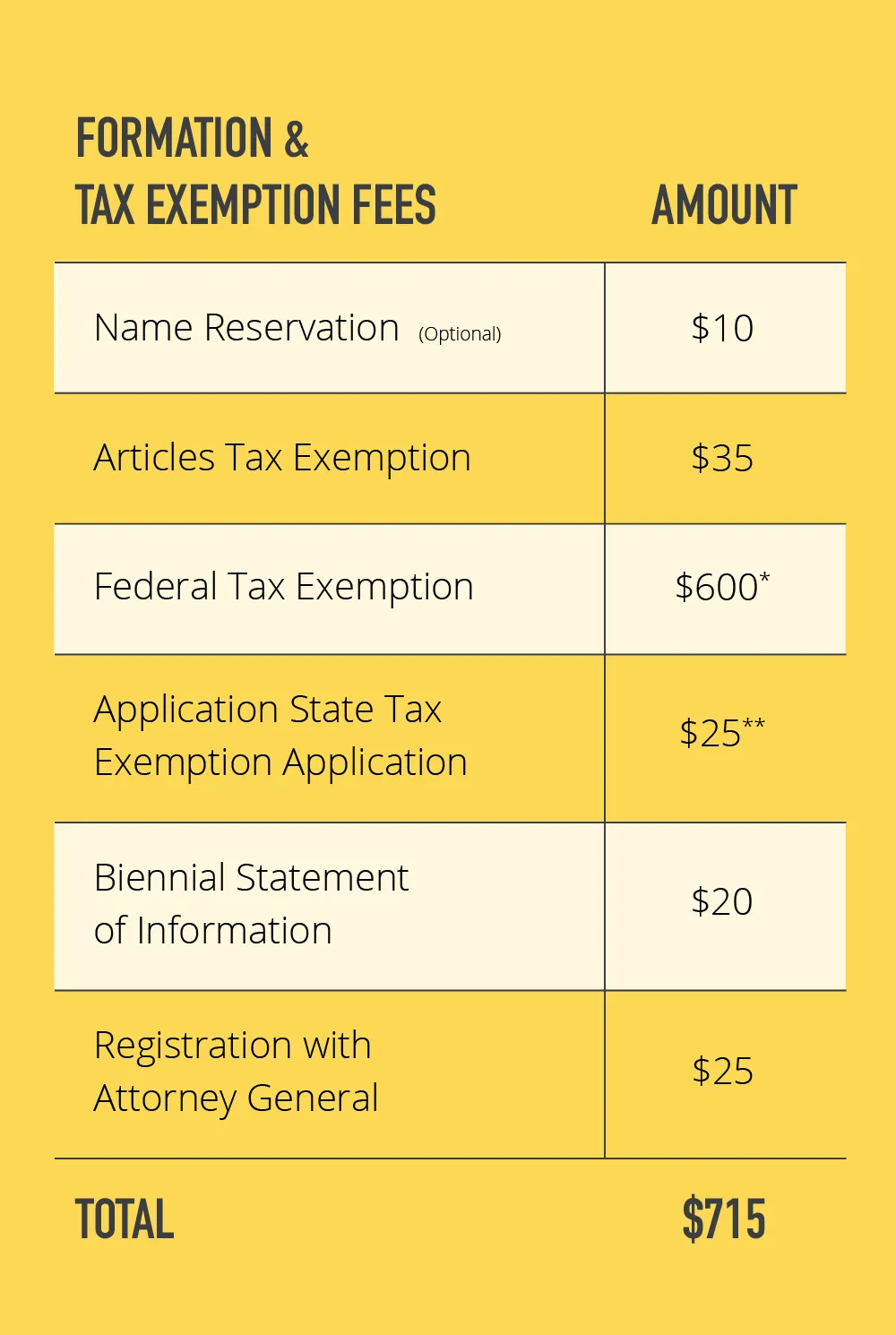
* For organizations eligible to file Form 1023-EZ, the filing fee is $275
** No fee with 3500A
Fiscal Sponsorship
When is it appropriate?
The proposed charitable program is small in scope, or temporary in nature
When the business plan is in its beginning stages
Additional Resources
Advantages
Ability to receive tax-deductible contributions
Ability to get off the ground faster
A wider base of support
Technical support /administrative support
Potentially lower insurance costs
Disadvantages
Surrender of control to the Sponsor
Administrative fee
Incorporation and Structure
Articles of Incorporation
This is the corporation’s basic organizational document
The Articles “create” the corporation
Employer Identification Number (EIN)
Every corporation that will apply for federal tax- exemption must obtain an EIN (IRS Form SS-4)
EIN is the corporation’s tax ID number for all federal tax purposes
There is no separate “tax-exempt” number
Just having an EIN does not mean that the corporation is tax-exempt
Bylaws
The Bylaws establish the procedures for governing and operating the corporation’s activities. The Board governs as a group and must vote as described in Bylaw
Typical bylaws provisions:
Number of Directors
Time, Place, and Manner of Director Meetings
Voting Procedures
Director and Officer Duties
Committee Structure
Amendment Procedures
The Board
Board Composition: 49% Rule
In a Public Benefit Corporation, no more than 49% of the board can be “interested” persons!
“Interested” means persons who have been compensated for services they provide (this does not include situations where the director is compensated for services provided as the director) during the previous twelve months, and their family members
Board Recruitment Matrix (pdf)
Legal Responsibilities
Duty of Care: Performing a good faith act, believed in the best interest of the nonprofit, with the care an ordinarily prudent person would exercise under similar circumstances
Duty of Loyalty: Good faith; Best interests of the corporation; Trustee relationship
Board Duties (adapted from Ten Basic Responsibilities of Nonprofit Boards, Board Source)
Determine Mission & Vision Select CEO
CEO Support/ Assessment Effective Planning
Build Competent Board
Financial Oversight
Monitor & Strengthen Programs
Enhance Public Standing
Ensure Legal & Ethical Integrity; Accountability
Ensure Adequate Financial Resources
Federal Tax Exemption
501(c)(3) Status
501(c)(3) organizations are eligible to receive tax-deductible donations because they are organized and operated for an exempt purpose such as charitable, religious, or educational.
Benefits of 501(c)(3) status:
(Mostly) free from federal income taxation
Donors may deduct contributions from taxable income
Eligible for foundation grants
Limitations of 501(c)(3) status
Must be organized and operated exclusively for exempt purposes
Must irrevocably dedicate assets to exempt purposes
Cannot confer excessive financial benefits on ‘insiders’ or other ‘disqualified persons’
Cannot provide substantial private benefits to ANY individual
Cannot support or oppose candidates for political office and may not devote a substantial part of its activities to lobbying
How to obtain 501(c)(3) status
File IRS Form 1023 Tax-Exemption Application Form ($600 application fee)
Form 1023 must be filed within 27 months of incorporation in order to obtain tax-exempt status retroactive to date of incorporation. Corporations filing after 27 months will be tax-exempt as of the application date. This means that they may have to pay income tax and all donations received prior to the application will not be tax-deductible.
Qualifying Purposes
Relief of the Poor
Lessening the Burdens of Government
Lessening Neighborhood Tensions
Elimination of Prejudice and Discrimination
Defense of Human and Civil Rights
Combating Community Deterioration and Juvenile Delinquency
Examples
Homeless Shelter
Affordable Housing Developer
Community Health Care Clinic
Job Training Program for Low-Income Individuals
Child Care Center
Domestic Violence Shelter
Youth Services Organization
IRS Form 1023
Provide Complete Description of Activities
Show that organization’s activities will serve the exempt purpose
Show that organization will actually conduct activities
Caution: IRS has denied exemption if the description is too vague to prove that activities are exempt.
IRS will scrutinize relationships with:
Founders
Board Members
Officers
Major Donors
Highly-Compensated Employees or Consultants
Other Private/For-Profit Persons
IRS Form 1023-EZ
Streamlined Exemption Process for Small Nonprofits
501(c)(3) self–certification process using a 3-page online form
$275 filing fee
Quicker processing time
Generally available to organizations that have had no more than $50,000 of annual gross receipts in any of the past 3 years, or have projected $50,000 annual gross receipts in the current and each of the next 2 years
However—24 additional exceptions (e.g., schools, colleges, churches, hospitals or medical research organizations, organizations with total assets in excess of $250,000)
Public Charity or Private Foundation Status
IRS divides all 501(c)(3) charities into two types:
Public Charity: supported by the broad public, or from fees for charitable services
Private Foundation: supported by one or a few private individuals or private foundations
Private foundations are subject to limitations and excise taxes and are not eligible for some foundation grants—operating charities try to avoid this!
IRS will grant permanent ruling as a public charity if qualifying budget is submitted on Form 1023 (Beginning in 6th year, must satisfy public support test)
Program Development
For each program activity, figure out the following:
Why does it further exempt purpose?
Who conducts it?
When is it conducted?
Where is it conducted?
How is it funded?
% of total time/$ spent on it
Charging For Your Services
There is no prohibition against a nonprofit charging for its services. But…
The activity itself should be related to the nonprofit’s exempt purpose—income from an unrelated activity will likely be taxable and may threaten the organization’s tax-exempt status
The activity cannot be run like a commercial enterprise
“Commerciality” factors—competition with for-profit entities, profit maximization, commercial pricing policies, etc.
Budget & Revenue
Current year plus two-year (detailed)
Form 1023 Sample Budget: EXPENDITURES

Form 1023 Sample Budget: Revenue
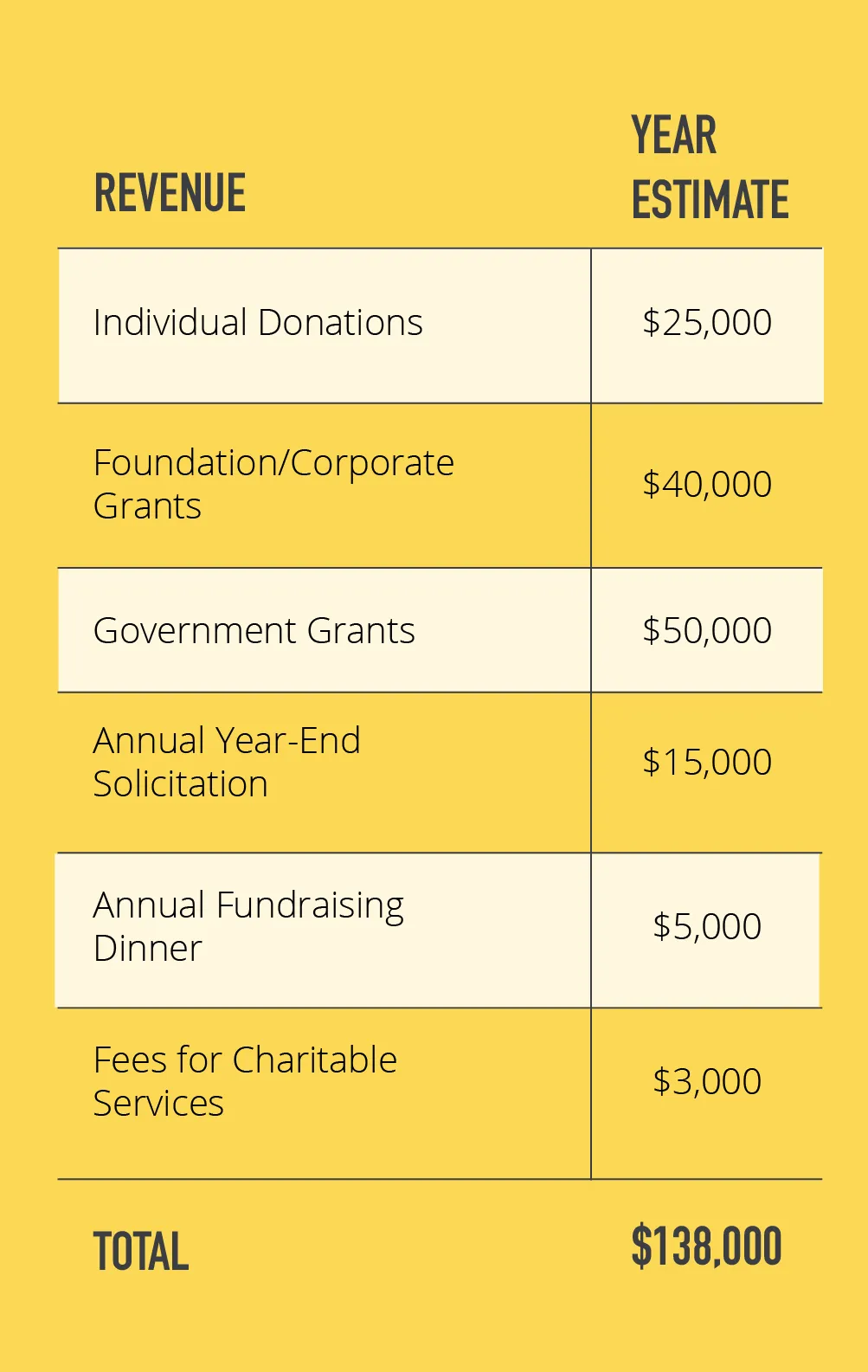
Developing a Program Budget (pdf)
Myths
Incorporation and tax exemption will NOT automatically generate grants or donations:
Many funders want to see a track record before giving any money
Grant resources are limited
Not quick money
Not all nonprofits generate enough revenue to pay salaries
Fundraising
4 Key Elements:
Program Planning
Building a Base
Building Relationship
Making the Ask
CA State Tax Exemption
Send IRS determination letter to Franchise Tax Board with Form 3500A
Note: you receive a letter from FTB specifying the effective date of exemption
– OR –
File Form 3500 with FTB
- For charitable organizations, fill out Section 23701(d) of Form 3500
Pay filing fee ($25)
Ongoing Compliance
Federal (IRS)
Form 990
Form 990-EZ if receipts $200,000 or less and total assets are less than $500,000
Form 990-N (ePostcard) if receipts $50,000 or less
Deadline & Notice
Due by 15th day of 5th month after the end of the organization’s tax year
Failure to file for 3 consecutive years = Automatic Revocation of Tax-Exempt Status
California
Form 199
Form 199-N if receipts normally $50,000 or less
Secretary of State: Statement of Information (SI-100)
After the initial filing, file every two years, or sooner to change information on file
https://businesssearch.sos.ca.gov/ – Status should be “Active”
Attorney General Registry of Charitable Trusts
Must register by filing Form CT-1 within 30 days after receiving or accruing assets
File annual report thereafter on Form RRF-1 and CT-TR-1 (if filed 990-N)
http://rct.doj.ca.gov/Verification/Web/Search.aspx?facility=Y (status should be “Current”)